The Heart of the Farm
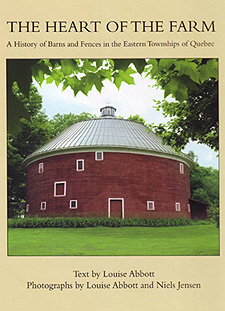 Well known Townships writer and filmmaker Louise Abbott has teamed up with her partner Niels Jensen to produce what will certainly be considered a fine addition to any library of Eastern Townships source material.
 A new publication, titled (in English) Cemeteries of Austin, is now available. Produced in pamphlet format, this 20-page fold-out brochure was researched and written by local historians Serge Wagner and Maurice Langlois, and was published in 2008 by the Austin Cultural Committee.
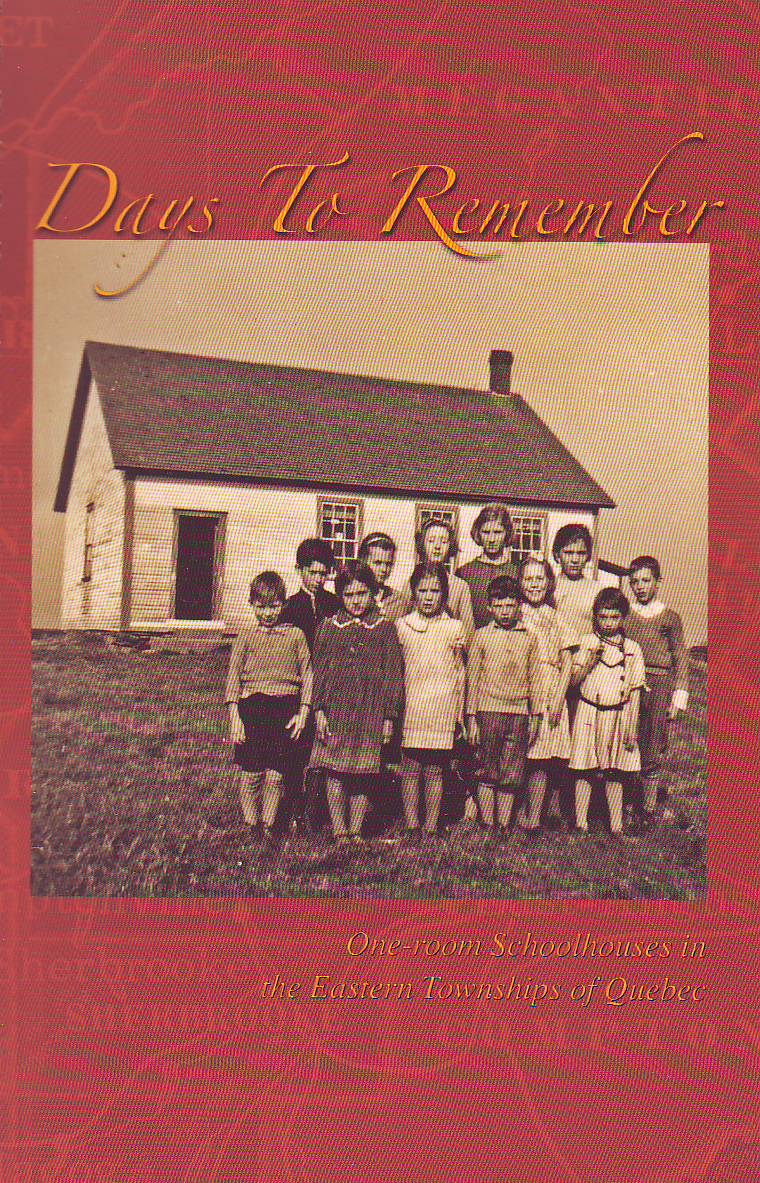 The one-room schoolhouse, so long the focus of folklore and nostalgia, is the subject of a new book. Days to Remember: One-room Schoolhouses in the Eastern Townships of Quebec, is the culmination of years of work by the Canadian Federation of University Women (CFUW), Sherbrooke & District.
Business account books or ledgers from the 19th and early twentieth centuries are a valuable resource for the study of rural history. Historians have used account books to reveal their subjects’ community through the markets they operated in, the people they dealt with, and the goods they produced and consumed. The time that went into creating these ledgers reveals the importance of the daily relationships they recorded.
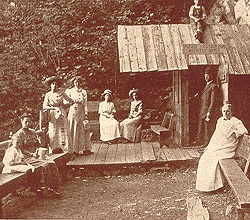 Built in 1875, Potton Springs Hotel and its famous sulphur springs attracted thousands of guests from all over eastern North America. The most important local attraction in its day, the spa had its own railway station and post office.
The conclusion of the American Revolution in 1783 brought forth profound changes to Quebec. The Treaty of Paris negotiated between the United States and Great Britain established the 45th parallel to the south and the span of land to the east, as the boundaries between this part of Quebec and the newly formed republic. In addition to these specific boundary agreements, close to 10,000 displaced persons, wishing to remain loyal to the British Crown chose to immigrate to Canada.
Anyone with more than a passing interest in the architecture and history of the Eastern Townships, in particular that part of the Townships bordering the U.S., will be interested to know that a new book has just been published on a type of architecture that, apart from the neighbouring states of New England, is quite unique to this part of Quebec.
“Woman is a bit of a slave in this country”
The Journals of Anne Langton, 1839.
The rise of the Patriote movement in the 1820s and 1830s was a crucial turning point in Quebec’s history. For Louis Joseph Papineau, the eloquent spokesman of the Parti Canadien who led the resistance to the unification of the Canadas, Lower Canada was a distinct and important territory to be preserved as a French and Roman Catholic home for its inhabitants.
Compton County Museum’s large and unique collections transport the visitors back to everyday life in the early homesteads and villages of Eaton Corner and Compton County in the 1800s. In December 1800, Eaton became a township which included Eaton Corner, Cookshire and Sawyerville, and by 1815, the population of Eaton Township was 600.